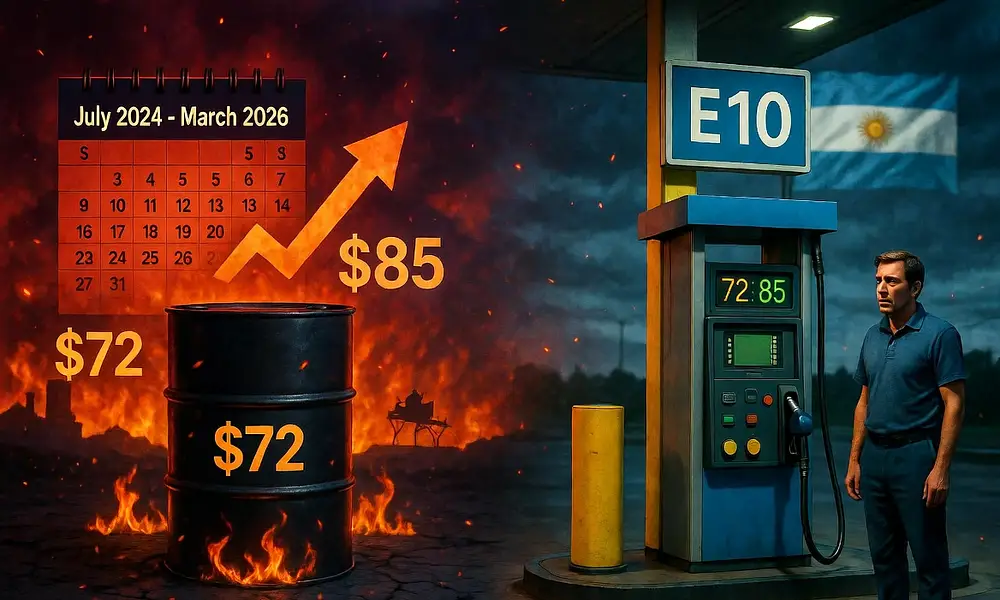
The Javier Milei administration faces a delicate dilemma: sustaining a disinflationary path with tariffs and prices under control, without breaking the finances of companies that also need investment to produce and export. Yet the very same price hike that raises inflation concerns provides a 'tailwind' for the external balance. Argentina produces around 860,000 barrels per day and exports on the order of 300,000, with Vaca Muerta as the growth engine and a petroleum complex that, in recent years, shifted from demanding foreign currency to import energy to generating dollars through export. Export capacity depends not only on price but also on the ability to evacuate crude to ports and expand logistics. In parallel, the government is closely monitoring the pass-through effect: gasoline and diesel impact logistics, food, and transportation, and thus can contaminate the price index. Recent hikes were already being felt before this shock: in Buenos Aires, March adjustments added another layer to a dynamic that was already seeing monthly corrections. On the local front, tension will be seen on three fronts: the pricing policy of YPF and other refineries; the effect on the inflation index and logistics; and the real ability to capitalize on the 'extra dollar' via energy exports, in a year where the government is betting that energy will be the backbone of foreign currency income. For the government and companies, the message is clear: a high price helps, but without pipelines and terminals, there are no miracles. The LNG chapter adds another layer to the scenario, with direct implications for Argentina's medium-term strategy. International reports describe that the conflict has already caused logistical disruptions, and if the crisis prolongs, the risks amplify: from changes in shipping routes and higher insurance costs to potential operational restrictions at regional terminals and refineries. In the domestic market, the 'side B' appears quickly: fuels. The impact is twofold, and for Argentina, it brings a known paradox: on one hand, it pressures the cost of fuels and can add inflationary tension; on the other, it promises a boost in foreign currency and profitability for a sector that has become a net exporter and is today one of the few concrete sources of genuine dollars. The immediate trigger was geopolitical. The conflict also hit the LNG market: Qatar Energy reported the suspension of LNG production following attacks on installations in Ras Laffan and Mesaieed, and the news pushed regional prices higher, with a domino effect in Europe and Asia. Qatar is a central player in the global market, and any significant disruption reorders flows, contracts, and spot prices. For Argentina, seeking to become an LNG exporter through liquefaction projects and agreements with specialized vessels, the situation serves as both a reminder and a window: Asian demand is growing, global supply is concentrating, and geopolitics can make supplier diversification valuable. In this picture, the oil price also impacts beyond energy: it pressures global inflation, tightens financial conditions, and strains bond and currency markets, as reflected in recent movements. If the shock persists, the world faces a classic risk of 'imported inflation' from energy, with effects on rates, activity, and consumption. Brent, a key reference for the local market, jumped in a few days to the $90 per barrel zone, with a weekly jump of over 20% and an accumulated advance in 2026 of around 50%, according to market reports. In recent hours, YPF's president and CEO, Horacio Marín, admitted the scenario is 'unpredictable' and hinted that if international prices remain high for months, the pass-through to the pump will eventually happen, although 'slowly'. With Brent about $20 above the average price that many base scenarios were handling for 2026, foreign currency income can improve significantly if the level holds, boosting associated revenue, improving company results, and giving oxygen to an external front that remains the country's main structural constraint. The opportunity, however, clashes with a concrete limitation: infrastructure. The plan foresees an initial transport capacity of around 180,000 barrels per day by late 2026, with a progressive expansion to 550,000 barrels per day in 2027, in a scheme that seeks to unblock the bottleneck and accelerate the export leap. The market moved from looking at relatively 'calm' fundamentals—with signals of oversupply and projections placing crude around $60—to discounting a risk shock in the Gulf due to the war, and especially due to the Strait of Hormuz, a bottleneck that channels a decisive portion of global energy trade. The crude jump pressures replacement costs and refining margins, and focuses on a practical question: what will YPF do, which concentrates more than half of dispatches at service stations and usually sets the pulse at the pump? In recent days, tension on that maritime route revived fears of interruptions in the flow of oil and gas, fueling the risk premium in prices and spurring volatility. The scale of Hormuz explains why the price reacts so violently. And Argentina, still fighting to consolidate macro stability, is exposed through two channels: on the negative side, costs; on the positive side, foreign currency. The big variable, admit in the market, is duration. About a fifth of globally traded oil and a very relevant portion of the LNG that supplies Asia and Europe pass through that strait. Here appears the Vaca Muerta Oil Sur (VMOS) project, key to connecting Neuquén production with a terminal in Río Negro and increasing the exportable volume. Buenos Aires - March 6, 2026 - Total News Agency - TNA - The military escalation between the United States, Israel, and Iran shook the global energy board and pushed crude prices to levels not in the base scenario of early January. In short, oil has again reminded of an uncomfortable truth: when the Gulf is on fire, the world pays more... and Argentina can earn more, as long as it can get its production to the world without hindrances. In this context, the Brent rise acts as an additional factor that can fuel the debate between refineries, the regulator, and the government itself, especially if the conflict does not de-escalate and the barrel stabilizes high. A brief peak may be absorbable; a high level for months changes the accounts.